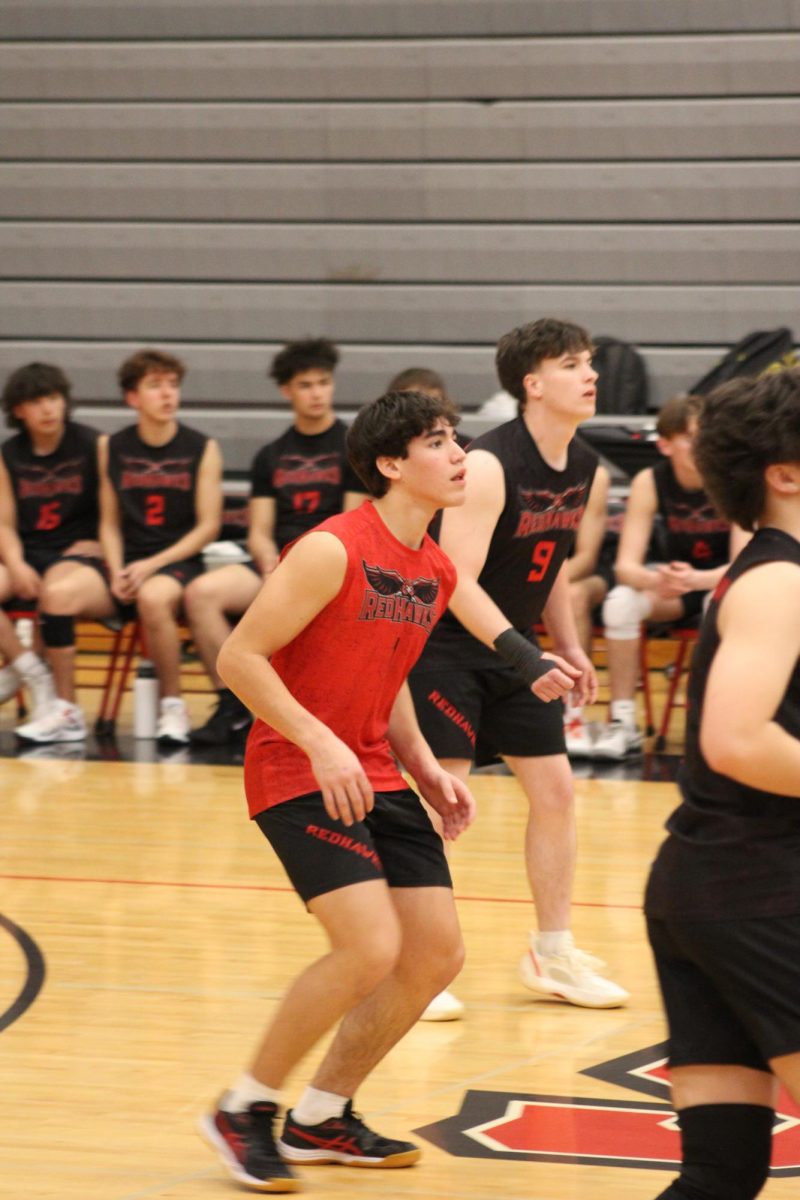
Disaster strikes when the Oregon Schools Activities Association (OSAA) suddenly makes boys’ volleyball a sanctioned sport, eliminating the West Albany High School and South Albany High School combined club. For two years, boys’ volleyball operated as a joint club between high schools; members gathered for their love of the game and played together as friends, not rivals.
“Now, it’s a fully sanctioned sport. It’s recognized by the OSAA and all the schools, but it also brings with it more requirements,” said boys’ volleyball Coach Geoffrey Berg. “Budgetary things, as far as number one now, you cannot have combined schools anymore.”
The combination of West Albany High School (WAHS) and South Albany High School (SAHS) made funding easy.
Junior Jaden Banks said, “We would drive around [to games], and it was all funded by us… He [Geoffrey Berg] would get us all hotel rooms.”
Being a club meant students paid their share to support the team, but when the school offers a sport, that doesn’t happen. Funding was discussed the summer before the 2025-2026 school year, and with OSAA’s late-in-the-game sanctioning, there was no wiggle room in budgeting to provide a team immediately.
“Bussing, coaches, stipends, officials, uniforms, equipment, all of that the district would be taking care of. [The] problem is we had already set our budget for this year, and when you do that, to take a sport that probably is going to cost about in the neighborhood of 25 to 30 thousand dollars per school, it would cost a lot,” WAHS Athletic Coordinator Don Lien said.
In theory, fundraising would be possible if the schools have even support. South Albany High School likely could not procure their funds this way because they do not have the same level of support West Albany High School does.
“There were a number of boys that played… but the support of West Albany has been a lot greater. We’ve had student leadership heavily involved, specifically [junior] Dima Stein, and we’ve had about thirty-five boys sign up on the interest list to play volleyball. So we’ve had a lot of the parents becoming involved that way. There just has not been anybody at South Albany driving that process,” said Berg.
The other issue with introducing boys’ volleyball is an imbalance between the gendered sports at the school.
“With Title Nine, you have to balance out the opportunities between male and female athletes, so if we add boys’ volleyball, what do we do about girls’ flag football?”
The plan had been to introduce boys’ volleyball and girls’ flag football at the same time, but OSAA sanctioned boys’ volleyball while girls’ flag football is still an emerging sport. Title Nine is a federal law created in 1972; it clearly prohibits sex-based inequality of opportunities between men and women’s sports. All schools have to offer equal treatment and opportunities for all athletes. Additionally, adding another sport would complicate things for multi-sport players.
“We’re offering a large amount of sports in the spring, eleven adding boys’ volleyball and twelve for girls’ flag football. Do we have enough athletes to be competitive in all twelve?”
Balancing time with practices is already difficult between our sports, and attempting to find a space and time for boys’ volleyball to practice would be incredibly complicated.
These hurdles the team faces are far from new. In the 2024-2025 school year, boys’ volleyball was facing similar challenges in terms of funding and play space.
“We paid around two grand [for] each person. We were also traveling a lot more,” said senior Derek Henriquez, “it’s not like [a] school [team] in the way of travel, we go to California, we go to Spokane, we travel to Portland with almost every single tournament.”
Not only are these issues known, but the team and coach have done their best to work around them.
“We have everything we need for the year to be started, [and] they’re just not letting us do it,” said Banks.
The sanctioning should’ve opened up more opportunities for the players, and instead it shut them down. The games were popular in attendance, and the bond of the team was strong.
“The team was very tight-knit. It actually was cool to see the collaboration between West and South and see guys from different schools come together and form a team-up.” said Berg.