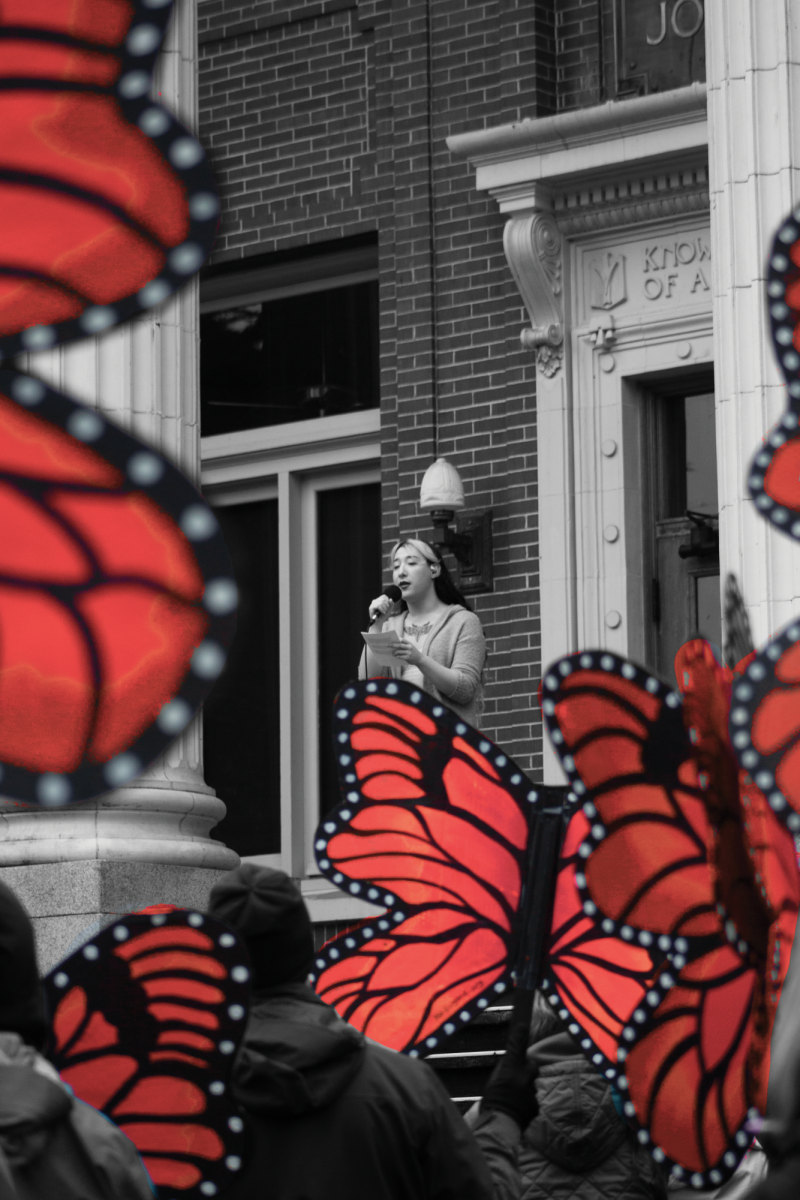
Headline after headline attempts to depict Portland, Oregon, as a place of violence and the cause of political fracture. Apart from the neatly written and scripted broadcasts from across the nation, the people of Portland and surrounding cities tell a different story. Portland isn’t a war zone; it’s people advocating for change.
“If you don’t feel comfortable speaking out against something, it allows negative things and corruption to thrive…the fundamental right is to speak out when you disagree with things, not use it in a negative way that can create more harm to our country,” psychology teacher Kyle Hall said.
Protests are a way for the average person to express their dissent over an issue while raising awareness on matters that are often overlooked. While some protests intend to be peaceful, the media primarily focuses on the violence, damage, and police presence.
“I think there was a narrative that wanted to be written, and they were trying to find certain areas of the country that it was fitting. Maybe there was something very aggressive and dangerous, but Portland wasn’t one of those places,” Hall said.
Protests are intended to remain peaceful; factors such as the presence of law enforcement and, recently, Immigration and Customs Enforcement (ICE) can escalate protests from peaceful to violent.
Under the new government administration, there has been an increase in protests regarding civil rights, authoritarianism, and immigration laws.
According to Oregon Public Broadcasting, 170 people have been detained during ICE raids and protests in recent months. “I saw people getting deported [when I lived in Portland],” said junior Sage Nelson.
On October 11, 2017, a group of protesters gathered to block an ICE bus in Portland, Oregon, leading to several arrests. Recently, on April 5, 2025, there was a nationwide “Hands off” protest.
“When it comes to the narrative that was written, that there was violence and it was burning, there was none of that. What it was trying to do was to try and get a base of people who are afraid of certain areas,” Hall said. People in the United States protest to get their ideas heard, but government officials play a role in bringing about legal change.
Throughout the nation, there are 12 sanctuary states, meaning there are limits to cooperation with federal immigration enforcement efforts to protect undocumented immigrants from deportation.
According to the 2025 Oregon Sanctuary Promise Legislative Report, there were 128 Sanctuary Promise Hotline contacts from June 1, 2024, through May 31, 2025, indicating U.S. ICE has violated the terms of Oregon’s Sanctuary Promise Act.
Currently, the District of Columbia is a sanctuary city; however, HR 2056, the District of Columbia Federal Immigration Compliance Act, aims to make the nation’s capital a non-sanctuary city. President Trump, in his Statement of Administration, said, “H.R. 2056 significantly advances the restoration of law and order to our capital.”
“Portland, being a true sanctuary city, is awesome. People can feel safe there, and that’s fantastic. The problem is that now it gives fuel for the groups that are opposed to [sanctuaries], they can vilify it and make it a really negative thing, that’s why Portland was looked at in such a negative place; it gives ammo to the other side,” Hall said.