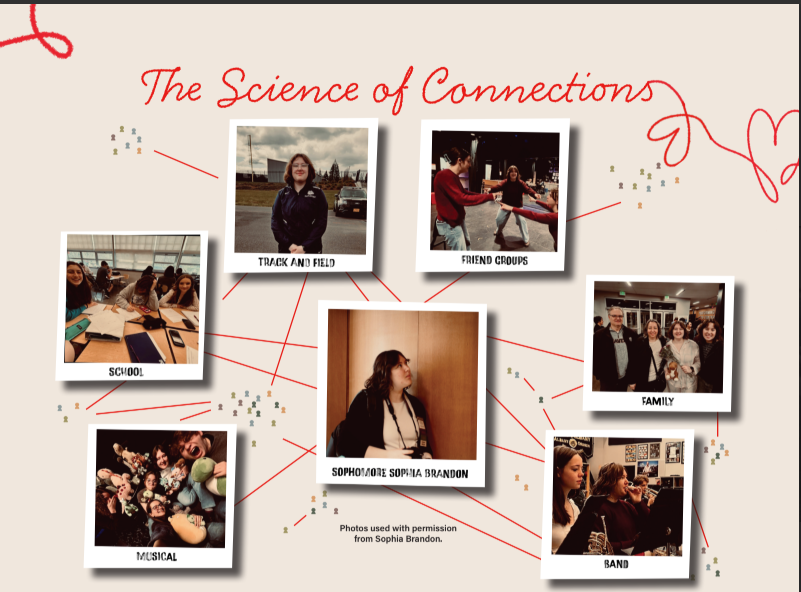
Having to rise early in the morning, stay after school for sports practices, and perform in the evening can leave a constant sense of going, with home being the one place someone can decompress and connect with family members. But for sophomore Sophia Brandon, when she gets home, her sister is nowhere to be found.
According to various psychologists, building connections with people is a fundamental part of human motivation and has evolved over centuries. The connection between humans used to be a resource essential for survival, but over time, it has evolved to sustain emotional and mental well-being.
Brandon’s sister recently graduated and has begun the next big chapter of her life, but in doing so has left Brandon with uncertainty to navigate new social environments.
“There is an occasional moment when I get to see my sister…But I feel left out, which makes it hard to reach out to people, even at school,” Brandon said.
For some, feeling out of place is more natural than feeling at home. According to psychologists Roy F. Baumeister and Mark R. Leary, in their study to understand the desire for interpersonal attachments, they explored the belongingness theory: A pervasive drive to form and maintain at least a minimum number of lasting, positive, and significant interpersonal relationships.
Relationships can form through religious affiliations, clubs, sports, school, family, work, and friends.
Moving away and having reduced spontaneous interactions with friends, family, and partners makes maintaining relationships harder for some.
“Connection is about putting in the effort to make sure my [relationships] last,” senior Morgan Glenn said.
The lives of individuals are closely intertwined with everyone else’s, and there is occasionally the fear of growing apart as people get older or move away from each other. But “clicking” with someone can take less than a minute.
“I still want to be part of the little things [after I move],” Glenn said.