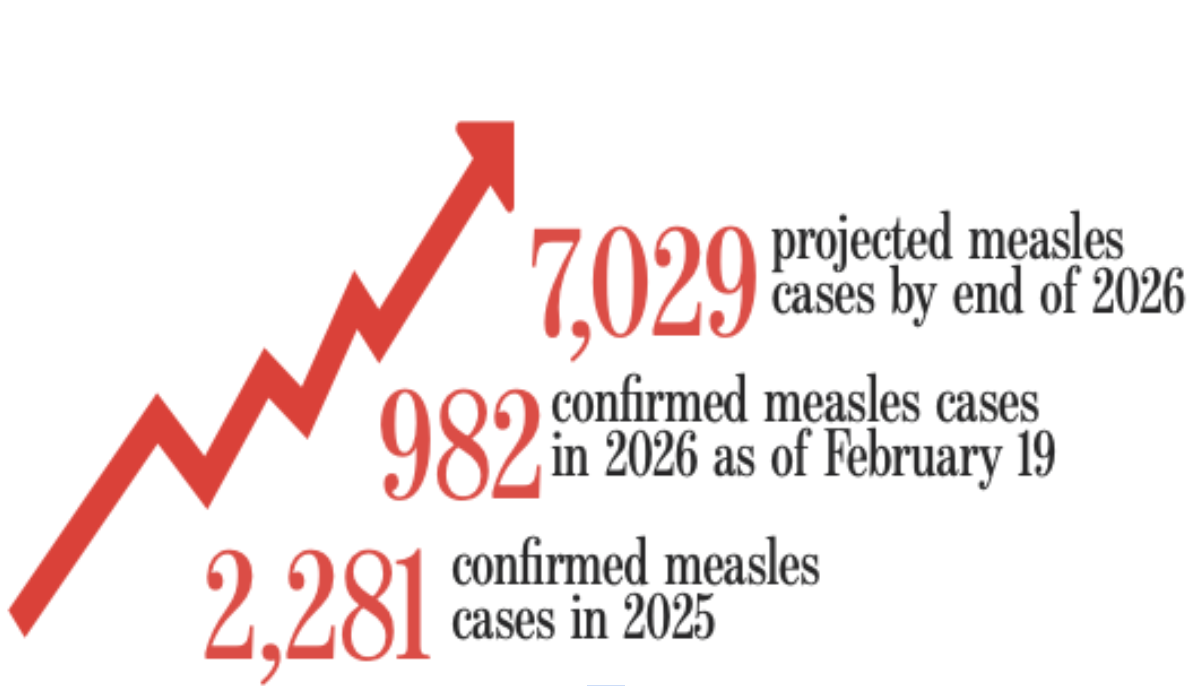
Since the COVID-19 pandemic, “vaccine” has become a loaded word. Beyond just a scientific solution to viruses wreaking havoc on our population, vaccines are now subject to heated political debate centered around fear. These perceived risks are often centered around invalid science, painting a less-than-complete picture of vaccinations. One example of invalid science may be the two Wakefield studies that came to the hypothesis that the measles, mumps, and rubella (MMR) vaccine causes autism.
“Anything can be a scientific study,” says science teacher Shana Hains. “The study was conducted and put out for peer review, but other scientists deemed the study invalid. That data was not valid.”
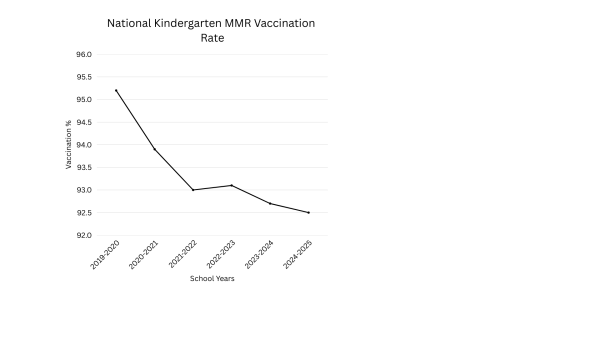
Despite this data being ruled invalid by qualified sources, such as the John Hopkins Bloomberg School of Public Health, the studies are often used as proof to fear the common vaccine. As the primary subject of the study, the MMR vaccine has taken one of the most significant hits. Since 2021, national MMR vaccination rates have fallen from 95.3% to 92.5% in 2025, prompting many to wonder about the effects this significant rate of decline might have.
“I think we’re going to see things like we’ve seen up in Washington in particular, where they’ve had little pockets of measles, they’ve had pockets of whooping cough,” says Health Occupations teacher Molly Morse. “The unfortunate part is that we aren’t going to see it in these big, huge numbers like the plague or Covid. Something that people are going to think, ‘Okay, maybe I do have a responsibility, or maybe I do need to look into why I chose not to vaccinate.’”
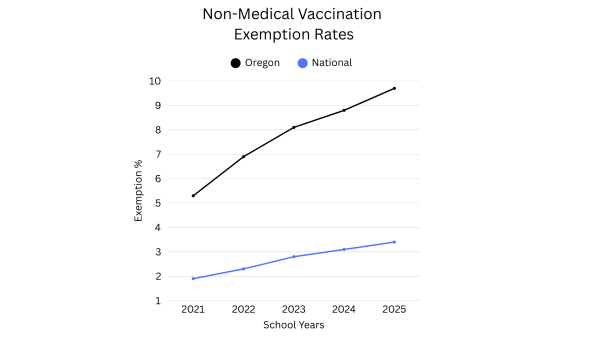
Being vaccinated can be seen as both a medical responsibility and a social responsibility. In fact, public schools require students to get the MMR vaccine to attend, but the number of non-medical exemption requests that are granted in Oregon schools has skyrocketed to nearly 10% of all students.
“I agree that there should be exemptions,” says Hains. “But if they aren’t medical, then we need to protect those who can’t protect themselves.”
It’s a hard issue for school districts to navigate. Vaccinating is a choice that all members of society have the right to make, but staying unvaccinated can be a safety risk to people in the vicinity.
“I believe in the fact that we’re all supposed to have the right to do what we want with our own bodies, but I think [we] tend to be a self-centered society,” says Morse. “We think about [ourselves] instead of what that is going to do to everybody else. What does it mean if we have five hundred kids at West Albany High School that are not vaccinated, and then we start having [viruses] show up? [The viruses] are probably not coming from someone that’s vaccinated.”